Archangel Foster Tabernacle of the Church of the New Revelation
Stranger in a Strange LandArchangel Foster Tabernacle of the Church of the New Revelation is the public religious complex where Mike, Jill, and Jubal encounter Fosterite worship at its institutional center. Its carefully managed entrances, commercial attractions, preserved founder, and dramatic services make the Tabernacle more than a setting: it is a built expression of a church that joins business, spectacle, and religious authority, and a point of contact between Fosterism and the community Mike will develop.
Setting and Public Entrance
The group arrives on a Sunday morning in a Checker Cab, chosen because Jubal refuses to trust an autocab with his life. The cab delivers them to a public landing flat just outside the sacred grounds. The approach already carries competing pressures: Senator Boone has been urged by Supreme Bishop Digby to produce the Man from Mars, while Jubal suspects that Mike may be wanted not only as a religious guest but also for the prestige his presence would bring. On the way, Jubal warns Mike that the church may seek his money and public association, and urges him to remain firm.
The route inside makes commerce part of the visitor’s religious experience. Boone explains that tourists enter through a long, high hallway whether or not they attend a service; the church runs services around the clock, and anyone heading for the bar or quick lunch must pass slot machines lining both walls. Boone presents the arrangement as an economic system in which visitors are offered chances to spend rather than simply asked for donations. The Tabernacle thus funnels movement and money through the same space, making its business interests visible within its sacred precincts.
The Preserved Founder and Sacred Space
A curved passage leads the visitors into a room Jill finds luxuriously appointed, with furnishings that remind her of an undertaker’s parlor and cheerful music with a dance-like arrangement. Its far wall is clear glass. Boone announces that they are in the Presence and points out Archangel Foster, seated in a large chair across the room. The church claims that Foster’s body remains unchanged by death, that the chair is the one in which he wrote his messages, and that he occupies the pose in which he was called to Heaven. According to Boone, the Tabernacle was built around him, with the old church removed and its sacred stones preserved.
This presentation turns a founder’s body, chair, and former church into a continuing source of authority. Yet the scene does not compel the same response from everyone. Jill feels uneasy before Foster’s appearance, while Mike asks her whether Foster is an Old One; she can only answer that the church says he is. The preserved figure is therefore both the focus of Fosterite reverence and an object whose meaning remains uncertain to visitors outside that faith.
Worship and Leadership
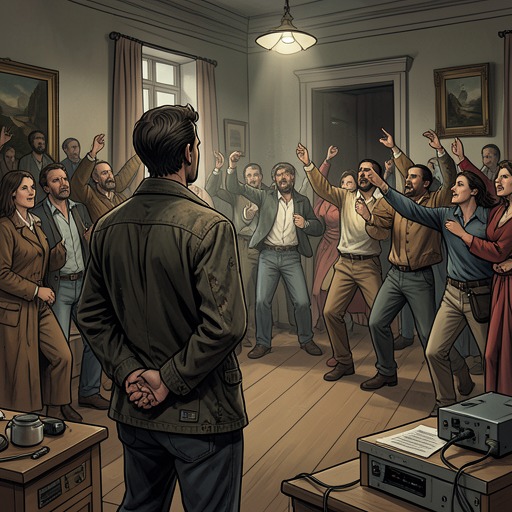
The building accommodates worship on a scale designed to absorb and amplify a crowd. During a service, the congregation chants for Digby with claps and stomps until the building seems to rock. Jubal jokes that the noise could have the effect of Samson, but Boone assures him that the structure is reinforced and fireproof, and says it was designed to shake. The exchange links the Tabernacle’s physical construction to the congregation’s collective performance: the building is presented as capable of containing, and even responding to, an exuberant service.
When the lights go down, the curtains behind the altar part and a powerful radiance illuminates Supreme Bishop Digby. The congregation answers with a roar, and Digby responds with kisses before proceeding toward the pulpit. The Tabernacle’s spectacle is not limited to its architecture or its preserved founder; it also depends on the leader’s direct engagement with the gathered worshippers. Afterward, Boone takes the visitors by a concealed elevator to Digby’s private apartments. There Digby, now in flowing robes rather than his public vestments, welcomes Mike and describes the church as the Lord’s house. The shift from public performance to a private parlor makes the building’s spaces serve different forms of authority, from mass ritual to personal access.
Encounter with Mike’s Practice
The Tabernacle visit becomes a point of contrast when Mike, Jill, and Patricia Paiwonski share water. Mike sends a glass from a drinks tray into the bathroom and has the tap fill it, then returns it to Jill. Jill explains that sharing water signifies trust, partnership, and an enduring bond, while emphasizing that Patricia is free to decline and that the rite should not conflict with her faith. Mike likewise urges her not to drink if she has any reason against it. Patricia chooses to accept; Jill and Mike drink first, and Mike then offers Patricia the water of life.
The scene shows the Tabernacle’s encounter with Mike’s religious practice not as a simple conversion but as a negotiation between different commitments. Patricia is a Fosterite, and her decision is made in the presence of Mike and Jill while she considers her own faith. The shared glass carries a relationship-changing meaning that cannot be reduced to a church membership or public profession. The physical rite also contrasts with the Tabernacle’s large-scale spectacle: trust is enacted through a freely accepted act among particular people.
Institutional Context and Legacy
The Tabernacle belongs to a church whose organization is described as deliberately layered. The New Revelation offers an outer church open to attendees who may remain seekers, and a middle church of saved members who support its expanding business connections and public religious life. Beyond these is an unnamed Inner Church: a closely selected priesthood and leadership circle responsible for keys, records, and policy, and regarded by its members as reborn and uniquely eligible for direct admission to Heaven. The Tabernacle’s visible attractions and services are therefore the public face of a larger structure, not the whole of it.
That structure draws on multiple organizational models and traditions. Foster is described as combining elements associated with freemasonry, Catholicism, the Communist Party, advertising, and earlier scriptures, while presenting the resulting religion as a return to primitive Christianity. Its public atmosphere of happiness and carnival, its business tie-ins, its hierarchy, and its central founder all converge in the Tabernacle. The building gives those elements a shared address and a public stage, even as its inner organization keeps some practices and authority beyond ordinary view.
Later, the congregation Mike establishes also develops circles, instruction, and membership practices, but the evidence distinguishes that community from the Fosterite institution. At the Tabernacle, Mike’s appearance has potential value to a church concerned with prestige; among his own followers, his teaching and miracles help people decide whether they are ready for further training and a place in the Nest. The Tabernacle thus serves as an important architectural and institutional counterpoint: a highly visible religious center whose order depends on spectacle and established authority, encountered by a visitor whose emerging practice puts trust and chosen relationship at its center.